Ingredients
Flour, water, salt. That’s the whole list.
Real bread needs very little. Everything a sourdough loaf is made of fits on one line, and none of it needs a chemistry degree to read. What it does need is something no factory can buy in bulk: time.
I
Flour
II
Water
III
Salt
+
Time, and a living starter
I · Read the label
Two loaves, two labels
Turn over a packet of sliced bread and the list runs to a dozen lines. Here is ours next to a typical one.
Our sourdough
- Flour
- Water
- Salt
Raised with a starter made from more flour and water.
A typical packaged sliced loaf
- Wheat flour, with calcium, iron, niacin and thiamin
- Water
- Yeast
- Salt
- Soya flour
- Vegetable oils (rapeseed, palm)
- Emulsifiers (E471, E472e)
- Preservative (calcium propionate)
- Flour treatment agent (ascorbic acid)
An example label. Recipes vary from brand to brand.
The extra ingredients are there for speed and shelf life. In 1961 British researchers at Chorleywood worked out how to make a loaf in about three and a half hours using intense mechanical mixing, extra yeast, fat and flour improvers. Today most packaged bread in the UK is made this way.
A sourdough loaf takes a day or two. The starter’s wild yeasts raise it slowly, and its bacteria make the acids that flavour the bread and help it keep. No improvers are needed, because time does their job.
II · Each one, closely
Small list, big choices
Flour
Flour sets the character of the loaf. Strong white bread flour, at around 12 to 14% protein, builds the gluten that traps gas and gives an open crumb. Wholemeal keeps the bran and germ, so it tastes nuttier, drinks more water and bakes denser. Rye has little gluten: it makes a sticky dough and a close, sour, long-keeping loaf. Spelt is an old wheat with a soft, extensible dough.
Stone-ground flour keeps more of the grain’s flavour. Our country loaf uses 90% strong white and 10% wholemeal.
Water
Water wakes the flour up and feeds the fermentation. Bakers measure it as a share of the flour’s weight, called hydration: around 65% gives a firm, easy dough, and 75% or more a slack dough with big, glossy holes. If your starter struggles, heavily treated tap water can be the cause, so try filtered water.
Salt
About 2% of the flour’s weight, and it does more than season. Salt tightens the gluten, so the dough holds its shape, and it slows fermentation, so the flavour has time to build. Bread without salt is pale, slack and bland. Plain fine sea salt is all you need.
Starter
The fourth ingredient, made from the first two. A starter is flour and water left to ferment until wild yeasts and lactic acid bacteria settle in. Fed regularly, it lasts for years. In Malta it is called il-ħmira.
III · Baker’s maths
Everything is a share of the flour
Bakers write recipes as percentages of the flour weight, so any loaf can be scaled up or down without guesswork. Flour is always 100%.
100%
Flour
70%
Water
20%
Starter
2%
Salt
For one loaf that is 500 g flour, 350 g water, 100 g starter and 10 g salt, exactly our country loaf. For two loaves, double every number.
IV · The invisible ingredient
What time does
Over 12 to 48 hours, the starter’s bacteria turn some of the flour’s sugars into lactic and acetic acid. Lactic acid is mild and creamy, acetic acid sharper and more vinegary. A warm, wet dough leans lactic; a cool, stiff one leans sour.
Those acids do practical work too. They help the bread resist mould and stay fresh for days, and they break down some of the phytic acid in wholemeal flour, which may make its minerals easier to absorb.
A word on gluten
Sourdough is still wheat bread. Long fermentation changes some of the proteins, but the loaf still contains gluten and is not safe for people with coeliac disease.
V · Words bakers use
A small sourdough dictionary
Ħmira, or levain
The starter, or a portion of it built up for one bake.
Hydration
The water in a dough as a percentage of the flour.
Autolyse
Resting flour and water together before the starter and salt go in.
Bulk fermentation
The first long rise, while the dough is stretched and folded.
Proof
The final rise after shaping, often overnight in the fridge.
Ear
The crisp ridge that lifts where the loaf was scored.
Three ingredients, one jar
Everything on this page begins with flour and water in a jar. Start yours today and bake in a week.
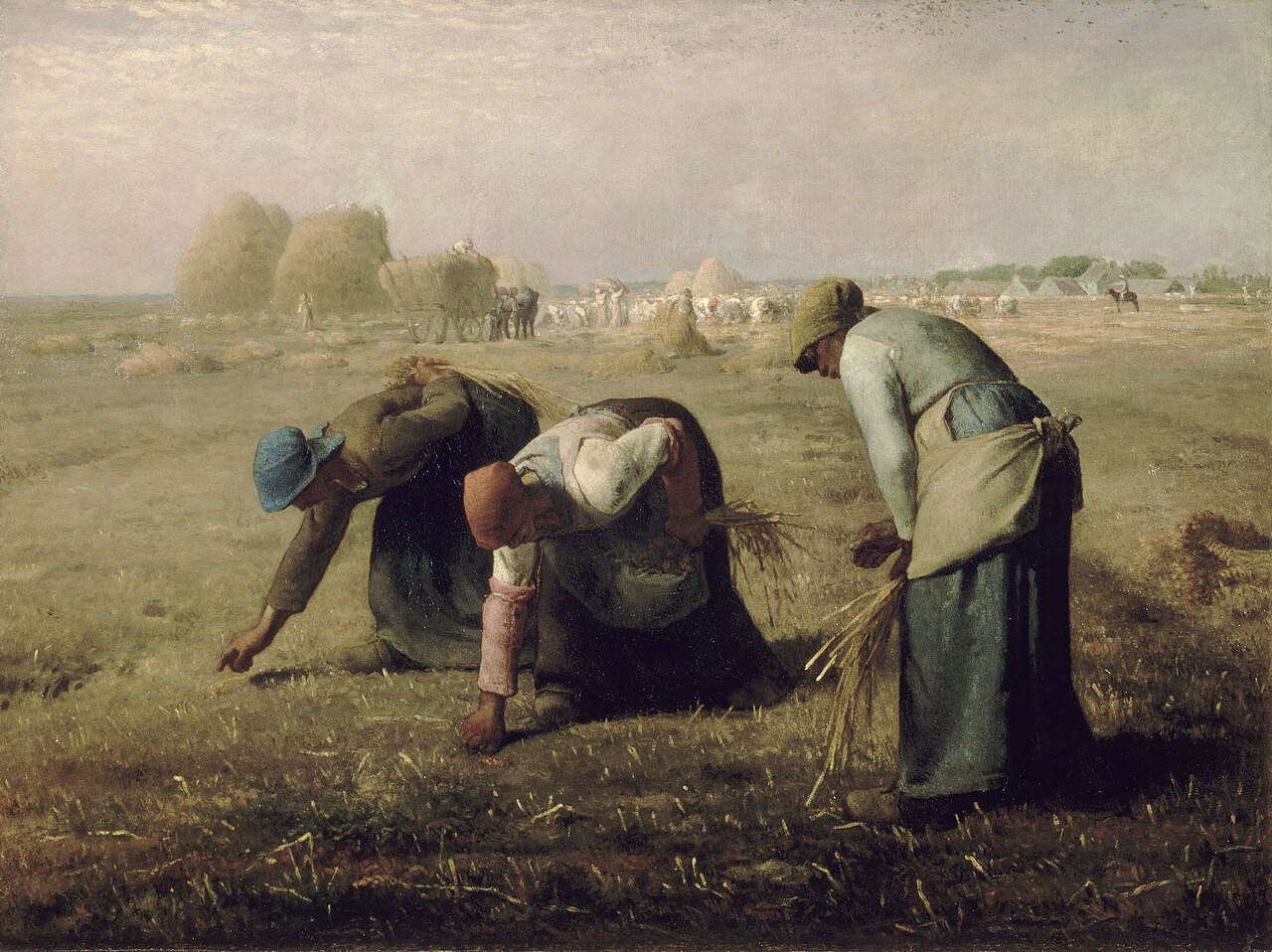
Painting: Jean-François Millet, The Gleaners, 1857 (Musée d’Orsay). Public domain, via Wikimedia Commons.

